

This week we have:
Jodi Taylor introduces author M.H. Foster
Author interview with M.H. Foster
February audio clip competition - guess the book and characters speaking for your chance to win a signed copy of Out of Time
A Symphony of Echoes is just 99p or 99 cents this month on Amazon
Short Story of the Month: The Very First Damned Thing - a chance to discover some of the St Mary’s short stories
There’s plenty to read this week and you can see everything on the blog too. CLICK HERE for the blog.
This week I’m delighted to introduce an author interview with M H Foster, author of the Gentle Apocalypse series that has very quickly become a favourite of mine.
Two books so far:
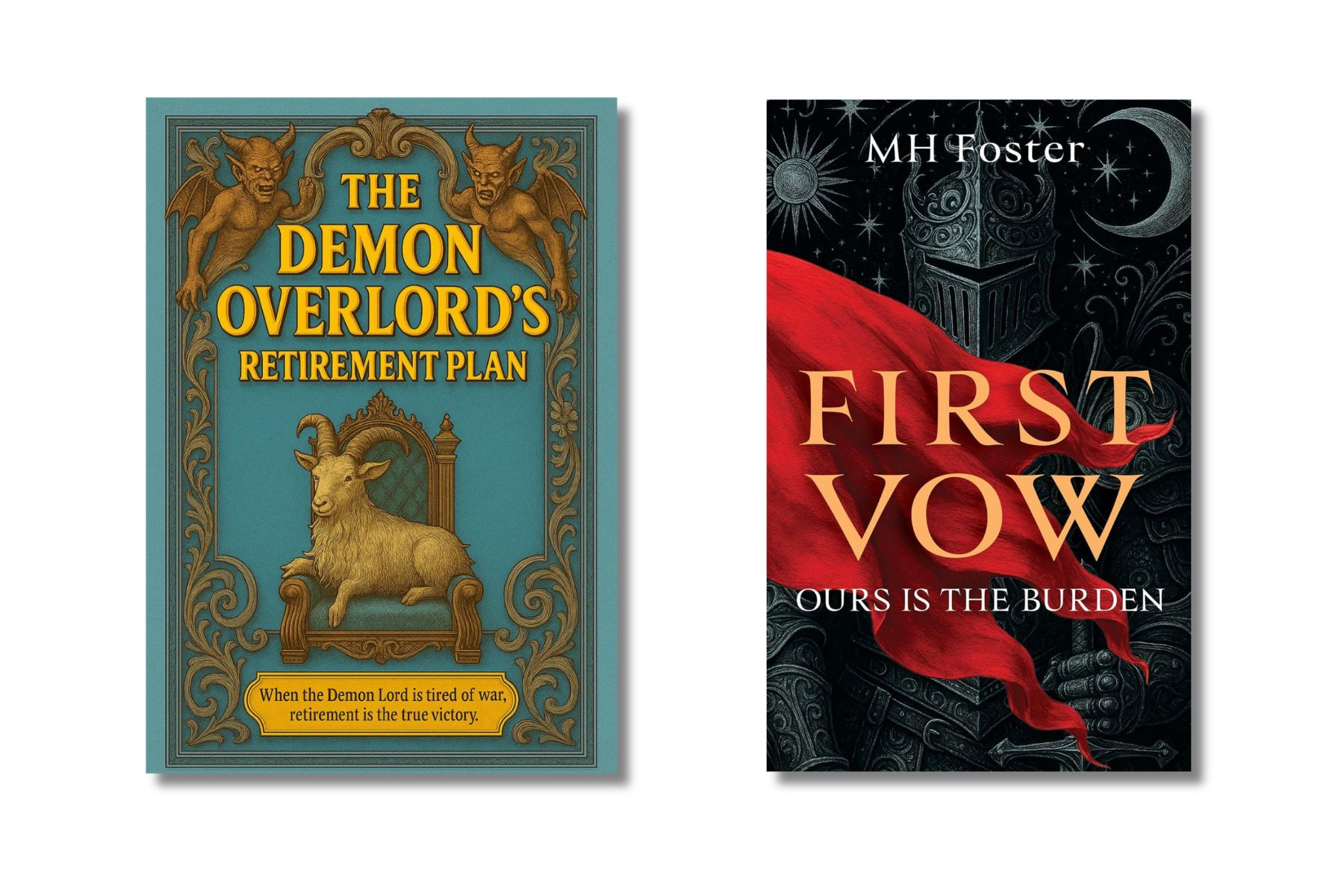
· The Demon Overlords Retirement Plan.
· Love, Politics and Other Acts of War.
With the 3rd book – Band of Others on pre-order.
It’s always fascinating to read of other people’s writing processes. Writing is quite a lonely business filled with self-doubt, procrastination and cheese, and it’s always good to have an insight into the way other people work. To be able to say, ‘Yes I do that.’
Or, ‘That’s interesting. I might give that a go.’
Or the inevitable, ‘Oh God, everyone’s so much better than me. I should find something else to do.’ I see a lot of that one at 3:00 in the morning
Incidentally, if anyone has any foolproof writing tips, please feel free to share them on this Substack.
Anyway, here’s the interview and many thanks to M H Foster.
Author interview with M.H. Foster
What inspired you to embark on a writing career, and how did your journey as an author begin?
I don’t think there was one thing that inspired me to embark on a writing career. A number of experiences provided the push to get me started.
A friend of mine had just published his first novel. I was impressed that he managed to find time despite his busy schedule. It made me wonder why I couldn’t at least try. I’d been thinking about writing for a long time and always had one excuse or another for why I couldn’t do it just yet.
I was also feeling stagnant at work and in life. Not because work wasn’t interesting or I was dissatisfied with how life was going. I just felt like I wasn’t learning anything new and life was sort of entering a holding pattern.
I began by writing short stories each week. Eventually, I came across Reedsy Prompts and saw a short story prompt (“Write about a second chance or a fresh start.”) that resonated with me. I entered the contest, one thing led to another, and I ended up writing Demon Overlord’s Retirement Plan.
It took a lot of discipline to complete the book, but it also brought me energy, a fresh perspective on things, and characters that could help me navigate my thoughts and feelings.
It hasn’t been long, but it’s been a fun journey.
Can you describe your writing process? Do you follow a structured outline, or is your approach more organic?
I consider my approach to be structured. I do not have formal writing training so keeping things organized helps me a lot. That being said, the most important part of my process is letting the characters drive the story instead of forcing them into unnatural actions.
For each chapter, I begin by listing the main points (events and dialogue) that would logically occur based on the world setting and characters. From there I write notes that expand the overarching brushstrokes into more detail. Finally, I take these notes and write the entire chapter.
I don’t usually have a clear idea of what will happen when I sit down to write. I think about the scenario or setting and then respond as if I were Willem or the character in question. These actions then drive the story forward organically. Sometimes I am surprised at what happens.
In my mind, my character exists in some corner of the multiverse. I’m simply writing down what actually happened to them. From that perspective, I feel like my writing is more like a dutiful recreation of events.
Overall, my structure exists so that I have a regimen I can follow with discipline. This helps me write consistently each day, and frees my mind to let the story tell itself.
I try not to pressure myself too much to write but I do set clear goals. Every time I sit down to write I try to make sure I complete the entirety of the task. Whether it’s scoping out the main points, filling in detailed notes, or writing out the full chapter, I usually do it in one sitting. Structure really helps in this case. By writing the main points and then filling in the details before writing the full chapter, I find that I save a lot of time and frustration.
This doesn’t mean I don’t throw away what I’ve written on occasion. For example the main points I write initially and the detailed notes often deviate substantially.
By writing the main points and the notes before finally writing the chapter, I’ve essentially written each chapter three times. This makes it easier to just write ideas down without worrying if it will be good as I always know that I will have a chance to fix it as part of the process. I find that this reduces the rate of failure substantially.
One thing I would suggest new writers consider is using AI as a tool for ideation, brainstorming or research. It’s really easy to give up and think that an idea isn’t any good, or to be too embarrassed to share it with someone. Or you just might be writing—like I often do—way too late in the evening and have no one you can bounce the idea with. You might also need to find out more about pickles and farming and need a quick data dump. In these scenarios, I think AI can be quite useful.
Which authors or books have significantly influenced your writing style and thematic choices?
I would say David Gemmell, Christopher Nuttall and John Scalzi had the most influence on my writing style and thematic choices.
In particular, I found Gemmell’s themes of redemption to be encouraging, and his characters inspiring despite their flaws. This directly led me to think about my characters as flawed individuals with possibly horrible pasts who still deserved a chance at a future with community and loving relationships.
Scalzi’s writing is incredibly creative while always following the underlying logic of his worlds. I try to follow his example. When I write, I always try to ask myself whether what happens is possible within my world’s logic or if I’m just writing a scene for its own sake without considering the whole book. Scalzi is also incredibly funny and his sense of humor has definitely been an influence as well.
Nuttall’s novels and their commentary on politics and economics have had strong influence on how I write. They’ve helped me flesh out the backdrop of the world my characters exist in. If I’ve done a good job ensuring my worlds have their own character from a political and economic standpoint, it has a lot to do with Nuttall.
How do you balance writing with other aspects of your life, and what strategies do you employ to maintain this equilibrium?
That’s a good question. I don’t think I have managed to balance writing with other aspects of my life to the extent I would like. Sometimes I feel like I get too engrossed in the world I am writing to the detriment of my relationships and work. However, I have tried my best to include my friends and family in my writing process. They aren’t bystanders, they are active participants.
Making sure I am not on the journey alone and I share the process has been the most effective way of maintaining equilibrium for me.
What challenges have you encountered in your writing career, and how have you overcome them?
The challenges I’ve faced in my writing career primarily stem from my own sense of insecurity. I constantly wonder if my stories are interesting or entertaining at all, or if I am just filling the world with garbage. Every time I begin writing after a long day I wonder if I’m wasting time and effort that I should be spending elsewhere.
I don’t think I’ve overcome my insecurity. I think I’ve just accepted that it’s a permanent companion. In a way, that’s made writing easier. It’s a constant reminder that I have a long journey ahead of me and there’s lots to learn and improve on and I don’t need to be weighed down by the expectation that I am any good. My insecurity helps me be fully comfortable that I have lots of room to get better if I just try harder a little bit more every day, even if excellence will always seem out of reach.
Friends and family have helped a lot in this area. They reminded me that it’s the journey that’s important.
The list of things I find challenging is long, but I’d like to focus on one that I think is particularly silly yet somehow managed to occupy a great deal of my brain.
Print book sizes. How do you decide? I found myself paralyzed with indecision. What if the book was too tall and wide, and as a result looked too thin and not worth picking up? What if I made it too small and then it’s so thick that people don’t want to try? It took me months and support from friends to help me choose. (They didn’t laugh at me. Too much.)
Could you share insights into your current or upcoming projects that you’re particularly excited about?
I’m currently working on books 3 (Band of Others) and Book 4 of A Gentle Apocalypse. Willem’s journey is a long one that’s just beginning and I’m learning lessons with him along the way.
In addition, I am finalizing Book 2 (Warmage) of my Janissary Series, which will be published on March 10th. This series is quite different from A Gentle Apocalypse. It’s darker, more military fantasy driven with a more serious tone.
There’s also another idea for a more modern setting that I’ve been noodling around in my head. Do hotels and demons sound fun? I don’t know yet. Too many thoughts floating around. I think I’ll let the character tell me the story once I put the first words down.
How do you handle periods of writer’s block or creative stagnation?
When I feel stuck I write short stories that take place somewhere in the world of Demon Overlord. It might be part of a character’s history, or something totally unrelated. Because Willem has lived for so many incarnations as Galornus Prime, there’s almost no limit to the possible experiences he’s had. This gives me a lot of freedom to just write without worrying about impacting my story plot. (Most of these stories will also never see the light of day so that helps too…)
The other method is structural. I write notes on what happens in a chapter. Even if they seem bad, I just keep going until the entire chapter’s outline is done. More often than not, some part of these notes gives me a new idea. I think the biggest problem is stopping. Once you lose forward momentum, it’s really hard to begin again.
What advice would you offer to aspiring authors navigating the path to publication?
Don’t stop. Ever. Keep writing. Even the worst sentence, the most boring idea or the dullest description you create has moved you forward. There is no such thing as wasted time on the journey. You can always go back, re-read it, and laugh at yourself. There’s some value in that.
How important are book reviews to you?
Extremely important. I read them constantly. This can quickly spiral into self-doubt, and I think it may not be a very good habit but I doubt I’m going to stop. That being said, I think the vast majority of reviewers are trying to be constructive and encouraging.
I wish I could respond to every review. I wish I could talk to the reader and ask them about the book. Even negative reviews, when they explain why, can be encouraging. They help me understand what I could improve on.
LINKS:
https://www.patreon.com/mhfoster
https://x.com/fostermh613

Read Jodi’s review of The Demon Overlord’s Retirement Plan CLICK HERE
FEBRUARY - GUESS THE BOOK COMPETITION

Guess the book and characters speaking for your chance to win a signed copy of Out of Time
Put your knowledge of Jodi’s books to the test with our audio clip competition. Listen carefully to a short extract and see if you can identify the book and the characters speaking for a chance to win a signed copy of Out of Time.
Audiobooks are hugely popular among Jodi Taylor fans, bringing her stories to life through distinctive voices, character-driven performances, and immersive narration. For many readers, audiobooks offer the perfect way to enjoy a favourite series while commuting, walking, or relaxing. They make stories more accessible, flexible, and engaging than ever.
Tune in, trust your ears, and see if you can name the book and the characters behind the voices.
The Very First Damned Thing - available in Kindle and Audiobook formats - also included in The Long and Short of It anthology
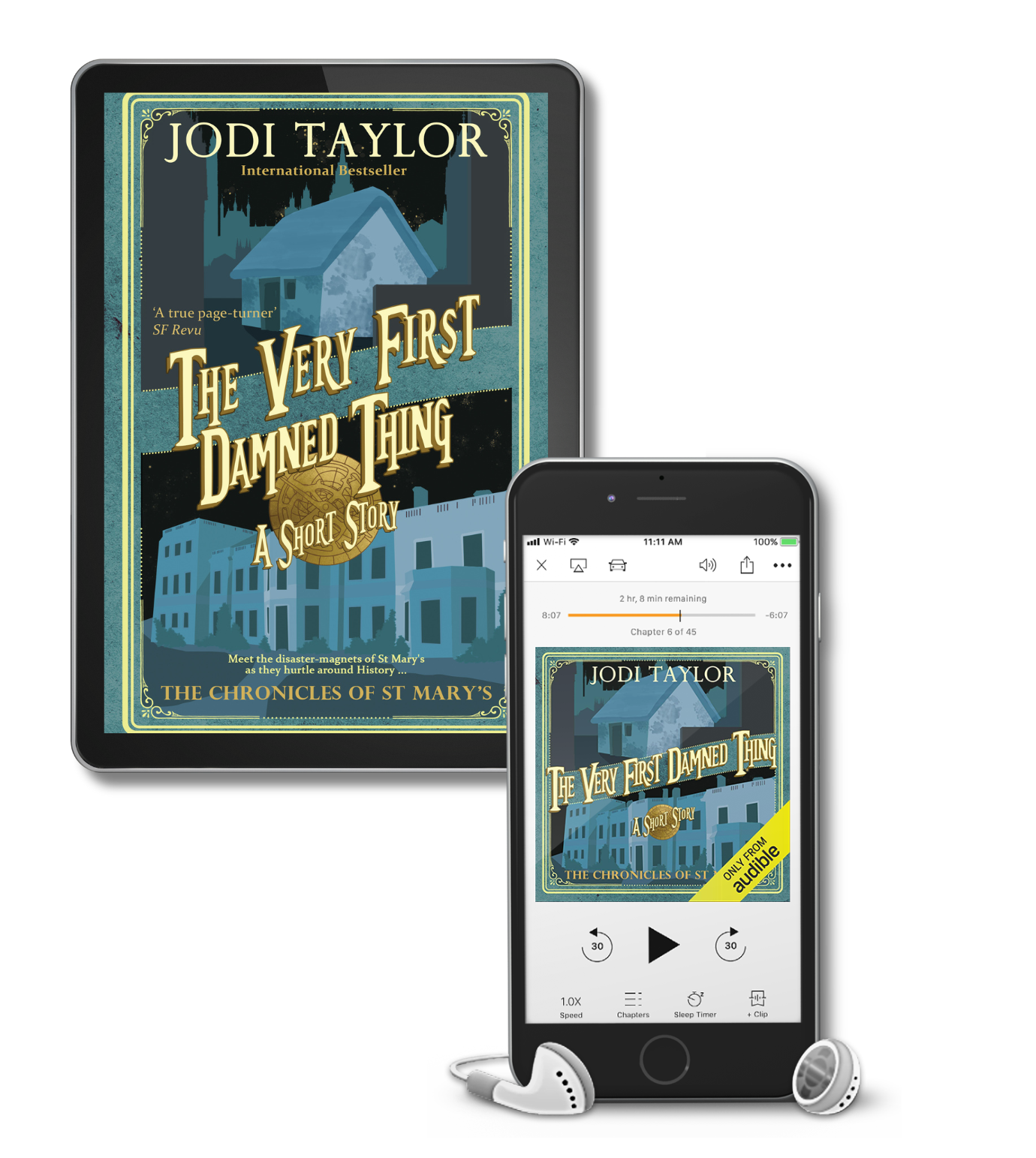
Ever wondered how St Mary’s came to be? This story follows Dr Bairstow as he embarks on the ambitious and seemingly impossible task of founding the St Mary’s Institute of Historical Research. As part of his strategy for official recognition and the funding that comes with it, Dr Bairstow takes a team of civil servants to witness the Battle of Waterloo in 1815. During the battle, they find themselves caught in the chaos of one of history’s most decisive battles and witness first-hand the brutal reality of Napoleon’s final defeat. With that secured, Dr Bairstow can set about recruiting the first generation of St Mary’s historians, security, and technicians, assembling a team that will define the institution’s unique blend of academic brilliance and bloody-minded recklessness.
Jodi Taylor says…
‘I think I’d written more than four or five books before I wrote this prequel. I don’t know why I was suddenly overwhelmed by a need to go back to the beginning but I did. Normally my overwhelming needs involve chocolate. I always say to people – don’t read this one first. Get a couple of books under your belt first otherwise some of it might not make sense. Which assumes the rest of it does…’
Questioning, even doubting, one's creative ability and creative processes is the mark of a great artist that motivates continual improvement, often unnoticed by the audience. Absence of self-doubt is the mark of egotistical arrogance creating at best stagnation and sometimes disimprovement - the sequels not being up to the standards of previous,
Thank you Jodi for being in the first group - keep questioning and your art will keep getting better.
Given that I love Gemmell, maybe I need to add another author to my TBR pile.