

1. ST MARY’S INSTITUTE OF HISTORICAL RESEARCH INCIDENT REPORT
Competition entry by Ricard Kelly
Mission Reference:
FML-1780-0247
Filed by:
Dr R. Winslow, History Department
Date of Filing:
17 March (current year)
I must state at the outset that the events described in this report were neither anticipated nor intentional, and that I followed standard observational protocols at all times. I appreciate that this distinction may provide limited comfort.
Mission Briefing
The objective was straightforward. Perform an observational jump to Morristown, New Jersey, in January 1780, where the anti-Imperial forces of the Continental War were making winter encampment. Observe, to whatever extent feasible under conditions as I found them, the assassination of General George Washington. A skilled general and orator, Washington had been maintaining his coalition of forces despite escalating tensions between rival generals. On his death, fragile unity transformed to open feud. France, already sceptical about backing the insurgents, withdraws its involvement. The rebellion was ground down through the following summer. The August Treaty, with its expanded legislative representation for Colonies, was signed within a year of Washington’s death. Most historical scholarship agrees that the assassination shortened the Continental War by as much as five years.
Several centuries later, the killer’s identity remains one of the great unsolved questions of Imperial history. Was it a Loyalist agent? A disaffected officer? A personal enemy? Our masters at Thirsk felt it was time we settled the matter. I was to observe, document, and return. Under no circumstances was I to interact or otherwise make my presence known.
I should like the record to reflect that I took this instruction extremely seriously.
Arrival and Deployment
I arrived at approximately 21:00 hours on the night in question. The Morristown encampment in January 1780 was, I can report with confidence, one of the most wretched places in the history of human habitation. The cold was immediate and absolute; not so much biting as swallowing you whole. The ground was iron. The air smelled of woodsmoke and unwashed wool. A particular variety of despair that I suspect has no modern equivalent hung palpably in the air.
I located Washington’s quarters easily. A modest timber-framed house had been commandeered for his use. I established an observation position in a shallow drainage ditch approximately forty yards from the entrance. It offered reasonable concealment but a clear sightline to the house. It also contained roughly four inches of frozen mud and what I believe was the remains of someone’s dinner.
I was calm, professional, and entirely in control of the situation.
Three hours passed.
I would like it noted that three hours in a drainage ditch in January, in New Jersey, in 1780, is not the same as three hours in any other context. The cold moved through stages: discomfort, then pain, then a curious numbness that was almost worse than the pain because it suggested that parts of me were simply giving up. My fingers stopped responding to instructions. My left knee developed a creak. I became increasingly concerned about the structural integrity of my nose.
At approximately midnight, I shifted position to relieve what I shall describe in this document as “a circulatory emergency in a sensitive area.” In doing so, I disturbed my equipment bag, which I had wedged beneath me for stability.
Something rolled out of the bag. Something bright yellow. Made of rubber. It was, unmistakably, a duck.
This was not my fault.
I do not know how it got there. I do not know whose it was. I have my suspicions, and I would like it on record that if it belongs to whom I think it belongs, we need to have a very serious conversation about equipment checks.
The duck bounced and rolled out of the ditch. It sat in the frozen mud of eighteenth-century New Jersey and gazed at me with an expression of relentless, painted cheerfulness.
The Incident
I attempted to retrieve the duck before it could be noticed. The previously-alluded-to circulatory emergency and a patch of ice combined to result in an involuntary lunge, which ended in landing on the duck. The duck let out a prolonged squeak. In the unique acoustics of a silent military encampment at midnight, it carried.
A guard came to investigate.
I lay face-down, motionless, heart hammering against the mud, the duck now clenched in my fist. The guard moved toward my position with his lantern raised. I stopped breathing.
He paused, set down the lantern, and raised his musket. He shouted a challenge.
But not in my direction.
Someone else was out there. A figure in a dark cloak. No lantern. Moving toward Washington’s quarters from the treeline to the north.
The figure ran.
More shouts. Torches flared across the camp. Boots on frozen ground. Washington himself emerged from his quarters, in his nightshirt and a state of considerable irritation, demanding to know what the devil was happening.
I slid back into my ditch and watched the assassin I had been sent to identify, the assassin whose name has eluded centuries of scholarship, disappear into the darkness at a dead sprint. A shape. A cloak. I could make it nothing more as he disappeared into the treeline and Washington shouted at his men.
The implications of this took approximately four seconds to arrive and have not stopped arriving since.
Return
I extracted myself at the earliest safe opportunity and initiated return procedures. The jump back was textbook. I arrived at St Mary’s, handed in my equipment, and proceeded to the debrief room. Everything appeared normal.
I sat down to type my report and pulled up a map to cross-reference my coordinates. I stared at it for some time.
Where the American Colonies should have been, there was a country. One much larger than the Colonies. It stretched from the Atlantic to the Pacific, and it was called the United States of America.
I searched for the British Empire. I found what was left of it. It had, according to the historical record now available to me, undergone a prolonged and apparently irreversible state of dissolution. India, gone. Africa, gone. And this independent republic of considerable size, now holding itself separate from the rest of the world, founded in the late eighteenth century following a successful war of independence.
A successful war of independence that appeared to have succeeded in large part because George Washington survived the winter of 1780.
Because a guard was drawn from his post by a noise.
Because a historian, lying in a frozen ditch, lunged for a rubber duck.
Assessment and Recommendations
The world to which I have returned is not the world from which I departed. I am, as far as I can determine, the only person aware of this fact, since everyone else’s memories are native to the current configuration of history.
I maintain that the proximate cause was a rubber duck of unknown provenance that should not have been in my equipment bag, and that a broader conversation about kit-packing procedures is both warranted and overdue.
The duck is currently in quarantine storage, locker 13B. I recommend it be destroyed at the earliest opportunity.
Respectfully submitted,
Dr R. Winslow
History Department
St Mary’s Institute of Historical Research

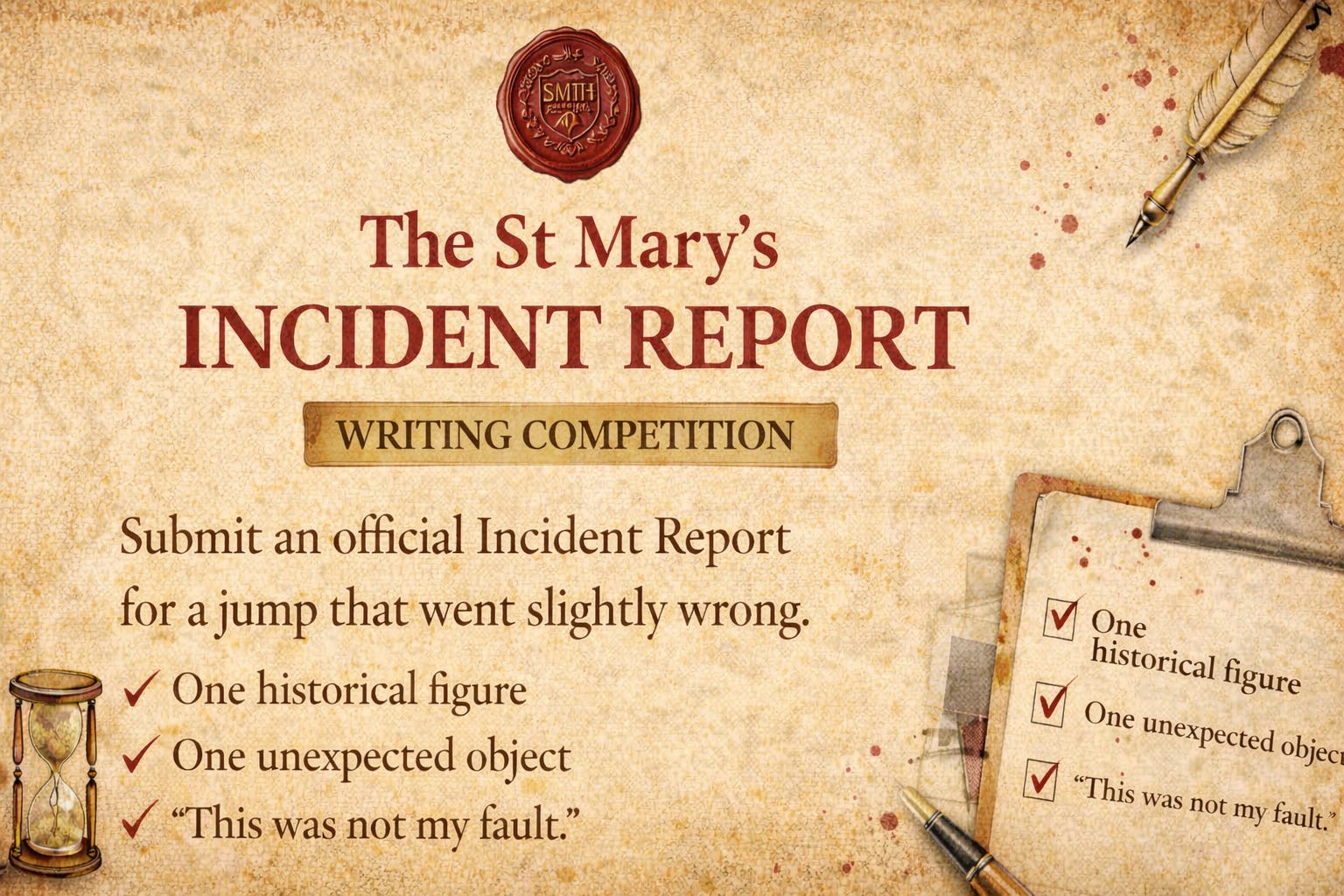
CLICK HERE for information on how to enter the competition.
 |
|
You read through something twenty times before hitting submit, and then find two errors the first time you read it afterward...
I enjoyed the read. As a Yank, i am glad George survived. Thanks Mr Duck