

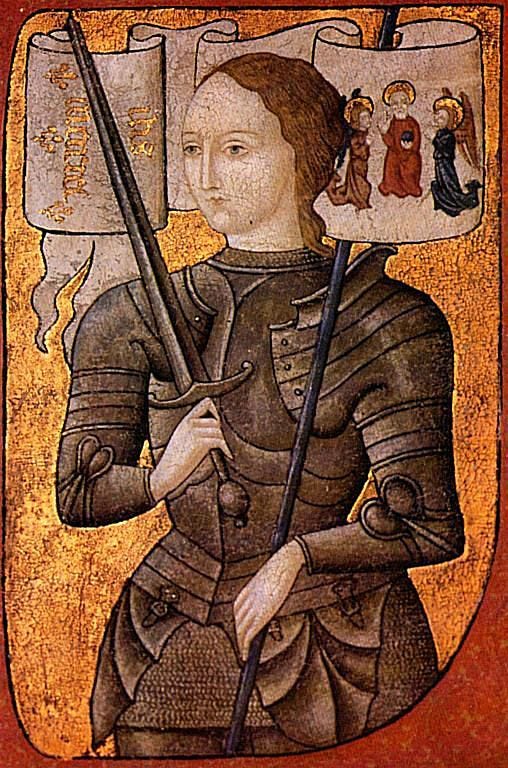
On January 6, 1412, in the small village of Domrémy, a girl was born who would later alter the course of French history. She became known as Joan of Arc (Jeanne d’Arc). Raised in a peasant farming family during a period of prolonged conflict, she grew up in a border region heavily affected by the Hundred Years’ War between France and England. France at the time was politically divided, militarily weakened, and partially occupied by English forces and their Burgundian allies.
At around thirteen years old, Joan reported experiencing religious visions and hearing voices, which she identified as those of St. Michael, St. Catherine, and St. Margaret. According to her later testimony, these voices instructed her to support Charles, the dauphin of France, and to help drive the English out of French territory. While extraordinary, such claims were not entirely outside the religious framework of the time, and Joan remained steadfast in her belief that she had been given a divine mission.
In 1429, after repeated attempts, Joan was granted an audience with Charles VII, who had yet to be crowned and faced serious challenges to his legitimacy. Despite her youth, illiteracy, and gender, Joan impressed both clerical examiners and royal advisors. She was permitted to accompany French forces, wearing armour and carrying a banner, and quickly became a powerful symbolic leader. Her presence helped inspire French troops and contributed directly to the lifting of the Siege of Orléans, a critical turning point in the war. Soon after, Joan escorted Charles to Reims, where he was crowned king in July 1429, fulfilling one of the central objectives she claimed had been revealed to her.
Joan’s success was short-lived. In 1430, she was captured by Burgundian forces near Compiègne and subsequently sold to the English. Seeking to discredit both Joan and Charles VII, the English placed her on trial in Rouen before an ecclesiastical court aligned with their interests. She was charged with heresy, witchcraft, and other religious offences, including wearing men’s clothing. The trial was marked by procedural irregularities, and Joan was denied legal counsel. Nevertheless, she answered her interrogators with notable composure and intelligence.
On May 30, 1431, at approximately nineteen years of age, Joan of Arc was executed by burning at the stake in Rouen. Her death did not erase her influence; instead, it intensified her symbolic importance. In 1456, a posthumous retrial authorised by the papacy annulled the original verdict and declared her innocent. In 1920, she was canonised by the Roman Catholic Church.
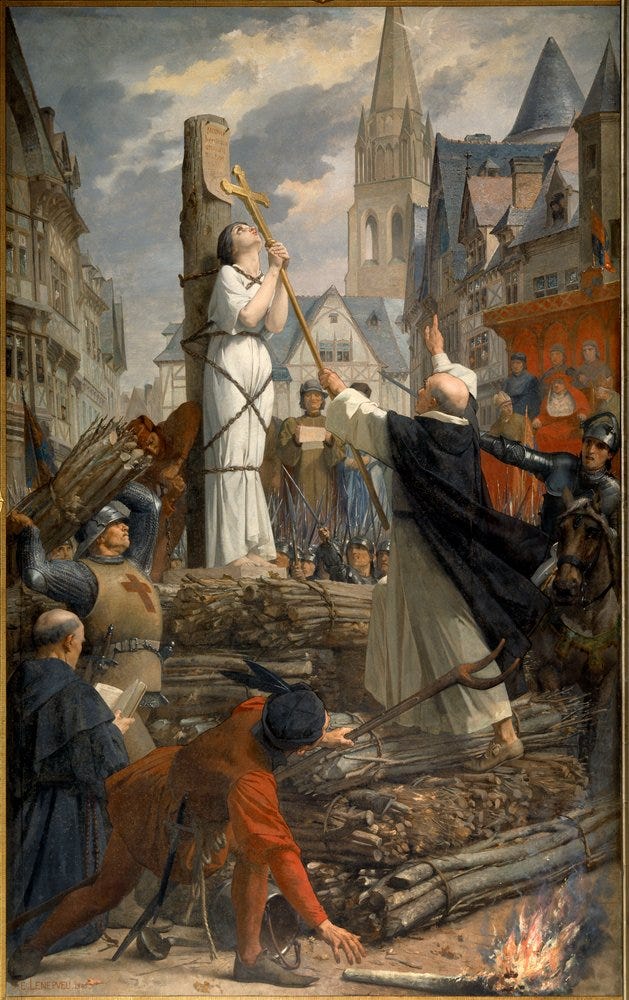
Joan of Arc’s life remains one of the most striking examples of how an individual from humble origins can shape major historical events. She lived only a short time, yet her actions influenced the outcome of a war, the legitimacy of a king, and the cultural and national identity of France for centuries to come.
Discover how Max and the team from St Mary’s fared when they witnessed the murder of Joan of Arc in What Could Possibly Go Wrong?

We hope you have enjoyed this History Briefing - please CLICK HERE to read more.

Have you discovered The Official Reading Companion and History Briefings for The Chronicles of St Mary’s series by Jodi Taylor?
If you've ever found yourself wondering who did what, when, and where in Jodi Taylor’s brilliant Chronicles of St Mary’s series — this is the companion guide you’ve been waiting for.
This guide is a must-have for both dedicated fans and curious newcomers. It contains synopses of every book and short story, detailed floor plans of St Mary’s Institute for Historical Research, History Briefings, chronological jump lists, character information, and more.
Whether you’re brushing up on the timeline or want to immerse yourself further in the chaos and charm of St Mary’s, this guide is your ultimate companion.
CLICK HERE to learn more.