

Author interview with Karen Baugh Menhuin
One of Jodi's favourite authors

Let’s start with the traditional opening while I struggle to get my brain in gear. Why and how did you begin writing?
I came to writing late. I was sixty when I started. At the time, I was helping my husband finish his autobiography. I was working with him on structure, setting out chapters, tightening passages, sorting phototgraphs, and somewhere in the middle I realised I’d always wanted to write a book myself. Not vaguely. Properly. So I did. There was no master plan. I simply sat down and wrote the sort of mystery I enjoy reading – traditional, complex, character-led stories, set in the 1920s. I didn’t think too hard about it. I just kept going until the book was finished. What surprised me was how much fun it was. The discipline didn’t frighten me. The research delighted me. The characters rather took over. One book led to another, and before long I had a series on the go. It turns out it was the right decision. Starting at sixty meant I didn’t waste time wondering whether I should or not, I simply got on with it. And I’ve been getting on with it ever since.
Do you plan it all meticulously beforehand with notes and diagrams and things, or do you just pick up a pen or open your laptop, think ‘What the hell?’ and just wing it?
I usually start with a situation, a body in an inconvenient place, a missing person, a gathering that’s bound to go wrong, and a fairly clear sense of who the characters are. After that, I write forward and see what happens.
That doesn’t mean it’s chaos. I know there has to be a solution, and I won’t begin unless I’m confident I can land the ending. But I don’t map every step in advance. Part of the pleasure for me is discovery, letting motives emerge, allowing characters to surprise me, following a thread that looks insignificant and finding it’s the key to the whole thing. I’m often surprised by the ending! That said, if I’m co-writing, everything changes. Then I have to be far more disciplined. It’s only fair. You can’t expect another writer to wander through the fog with you while you say, “Trust me, it’ll make sense in the end.” In that case I produce a proper, detailed plot outline, chapter by chapter, turning points, reveals, red herrings, the lot.
Left to my own devices, I open the laptop, think ‘Right then’, and get on with it.
Which book was the most fun to write?
Murder at Melrose Court. My first book, where a body is found on the doorstep of Major Heathcliff Lennox. It’s really quite a humorous book too, shades of PG Wodehouse permeate it. Lennox has matured since then, and is a bit more serious about murder, but the very English dry humour remains
If you couldn’t write what would be your second choice of occupation?
If I couldn’t write, I’d probably fall back on something I already know how to do. I trained and worked as an accountant in the defence industry, which is about as far from fictional country house murders as one can reasonably get. It taught me discipline, precision, and how to follow a trail of numbers until it made sense — all of which, as it turns out, are surprisingly useful in plotting crime novels.
I’ve also renovated houses over the years, and that remains a genuine passion. There’s something immensely satisfying about taking a tired building and coaxing it back to life, making practical decisions, solving problems as they arise, balancing vision with budget. It’s creative, but grounded. You can stand back at the end of the day and see exactly what you’ve achieved.
That said, in theory at least, being a private investigator would be the most fun. The idea of quietly observing, asking careful questions, piecing together inconsistencies, it appeals enormously. Though I suspect I find it appealing precisely because I haven’t had to do it for real. In fiction you get the satisfaction of the puzzle without the paperwork, the danger, or the awkward clients. Real life might be rather less romantic.
So perhaps the sensible answer is renovation. The more entertaining answer is private investigator. And the practical answer is that I’ve already tried accounting, and I much prefer writing.
Do you ever have an urge to go completely off-piste and do something completely different? A bodice-ripper, perhaps or a cosy detective story, just for the sheer hell of it?
I think every writer occasionally feels the itch to wander off in a different direction.
In my case, I actually did.
The Heathcliff Lennox books are traditional country house mysteries, layered puzzles, families with secrets, a body in the library sort of thing. I adore writing them. But there came a point when I wanted something sharper, darker, a little less contained by drawing rooms and afternoon tea. That’s how The Alexander Wolfe series began. It’s still set in the same interwar world, but the tone is very different, spies, assassins, shadowy organisations, vast wealth and the sort of power that operates behind closed doors. The stakes are higher, the moral lines less tidy. It’s allowed me to explore a more dangerous side of the 1920s. So yes, I’ve gone off-piste and I’ve loved it. It stretches me in a different way. The plotting is tighter, the atmosphere more taut, and the world broader. I’m not sure I’ll ever write a bodice-ripper, but never say never. The joy of writing is that you’re not obliged to stay in one room forever.
Which book would you take to a desert island with you? Other than one of yours or one of mine, of course?
I’d take The Lord of the Rings by J. R. R. Tolkien.
If I’m to be stranded, I want something substantial. It’s not merely one story but an entire world; history, language, maps, songs, the lot. You could read it for the adventure, then read it again for the detail, and a third time simply to admire the sheer craft of it.
There’s also something rather appropriate about reading The Lord of the Rings on a desert island. A long journey, sparse provisions, questionable companions, and the occasional sense that everything depends upon quiet endurance.
It would keep me occupied and possibly civilised.
Serious question – how easy or hard is it for you to go back and re-read your own work?
It’s easier than you might think, though perhaps not in the way people imagine. I don’t often sit down and re-read my books silently to myself. That feels slightly too much like marking my own homework. But I do listen to them, especially on long car journeys, with my husband. Audiobooks are a different experience. You hear the rhythm, the dialogue, the pacing in a fresh way.
Sometimes I’ll wince at a sentence I’d phrase differently now. Occasionally, I’ll think, “That was rather well done,” which is reassuring. Mostly, though, I find I’m listening as a reader rather than as the author. I’ve usually forgotten enough of the finer detail that the story carries me along.
It’s also useful. You catch the odd repetition, the slightly overlong passage, the place where you might tighten things next time. But on the whole, I’m rather fond of them. They represent a particular moment, where I was, what I was thinking, how I was writing at that point in my life. And long journeys are much improved by a good murder.
What are your plans for future books? What can we look forward to in the coming months?
The Player in the Game, which is book 3 in the Alexander Wolfe series should be released at Easter. So should The Chester Grand Murders, book 18 (I think) in the Heathcliff Lennox series, and book 5 in the Miss Busby Investigates series is about to be released any day now – The Mystery of the Midnight Swan
Which authors or books have significantly influenced your writing style and thematic choices?
One of the strongest influences on me has been Lindsey Davis and her wonderful Marcus Didius Falco series. What I admire most is the voice. Falco narrates with wit, intelligence, and just enough irreverence to stop the history feeling heavy. The books are meticulously researched, yet they never read like research. The world feels lived-in rather than displayed. That balance, authenticity without pomposity, is something I’ve always aimed for.
I’m also drawn to the way Davis blends humour with genuine stakes. The mysteries are clever and properly constructed, but there’s warmth in the relationships and a sense of the ordinary human muddle beneath the larger political currents. That mixture of crime, character, and a vividly realised past certainly shaped how I approach my own 1920s settings.
If I’ve borrowed anything at all, I hope it’s that tone: intelligent, lightly worn, and never taking itself too seriously, even when the murder most certainly is.
How do you balance writing with other aspects of your life, and what strategies do you employ to maintain this equilibrium?
Balance is perhaps too dignified a word for it. live a fairly insane, hectic life. I had imagined drifting gently into retirement, more reading, more gardening, perhaps the occasional long lunch. Instead, I appear to have built several book series, a publishing business, and a schedule that would alarm any sane person.
The truth is, I don’t wait for perfect conditions. If I did, nothing would be written. I write in the gaps, early mornings, between calls, on trains, planes, wherever there’s a quiet hour to be had. I treat it as work, not as something that must wait for inspiration or tranquillity.
I’m also quite structured about it. I set realistic daily targets, and I meet them. A thousand words a day if I can. Some days are better than others, but steady progress matters. Discipline is far more useful than drama.
That said, I’ve learned to be pragmatic. Life occasionally takes precedence, family, travel, the general chaos of running things. When that happens, I don’t panic. I simply return to the desk the next day and carry on.
What advice would you offer to aspiring authors navigating the path to publication?
Do not be deterred. That sounds simple, but it’s the crux of it. There will always be reasons to stop; rejections, slow sales, unhelpful opinions, your own doubts. If you allow any one of those to halt you, you won’t get very far.
Finish the book. That alone puts you ahead. Then make it as good as you possibly can. Edit ruthlessly. Cut what doesn’t work. Listen to sensible criticism and ignore the rest.
Also, understand that publication is no longer a single narrow gate guarded by a handful of people. There are options. Traditional routes, independent routes, hybrid approaches. Learn the business side as well as the creative side. Writing is art; publishing is commerce. You need at least a working grasp of both.
Most of all, keep going. Careers are built on persistence far more often than on sudden brilliance. If you believe in what you’re writing, and you’re prepared to work at it properly, don’t let temporary setbacks persuade you to abandon it.
The only guaranteed failure is stopping.
How important are book reviews to you?
Vital. Reviews matter, not merely to the ego (though one would be lying to pretend they don’t sting or delight), but to the practical reality of selling books. They provide social proof. They reassure a hesitant reader that someone else has taken the plunge and enjoyed the journey.
In the online world particularly, reviews influence visibility. Algorithms notice them. Retailers notice them. Readers certainly notice them. A strong body of thoughtful reviews can give a book momentum that no amount of quiet hope ever will.
That said, one has to develop a slightly thick skin. Not every reader will love every book, and that’s perfectly reasonable. If ten thousand people enjoy something and one does not, the book hasn’t failed, it has simply found its audience.
So yes, reviews are vital. I value them enormously, especially from readers who take the time to write a few considered lines. They make a tangible difference, and I’m always grateful for them.
https://www.facebook.com/KarenBaughMenuhinAuthor
Read Jodi Taylor’s review of The Caxton Manor Murders by Karen Baugh Menhuin and Matilda Swift and The Belmont Affair by Karen Baugh Menhuin and Nicki Mason.
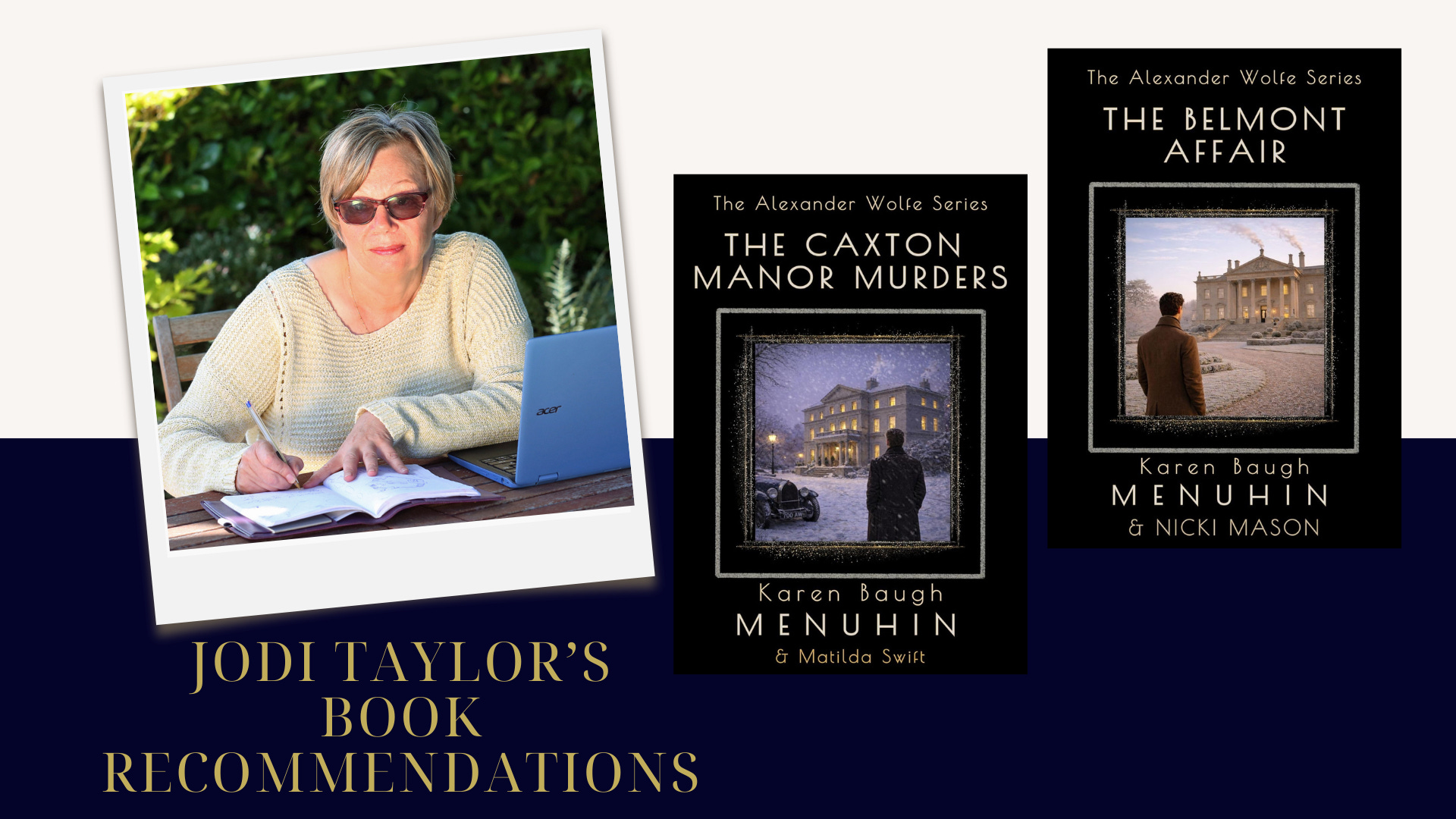
I first encountered Karen Baugh Menhuin when I discovered her excellent Major Heathcliff Lennox series. Of which I think there are sixteen or seventeen books, so plenty to get your teeth into.
This new series is very similar, being set in the same period – just after World War I – and against the classic backdrop of well-staffed country houses. The unconventional hero – Alexander Wolfe – is an ex-spy who served in the war and is now retained by the Home Office in the form of Lord Hector Sommerton who certainly doesn’t believe in sending his people into the field fully briefed. Or sometimes, even briefed at all.
In both books Wolfe is called in to investigate murders that, in addition to being mysteriously suspicious, have complicated diplomatic situations to be untangled as well, providing Wolfe and his team – the enigmatic but likeable James Fox, the endearingly enthusiastic valet Dicks, and a mischievous terrier Wilf – with seemingly unsolvable problems.
These stories are less light-hearted than the Major Lennox tales but none the less enjoyable.
The third in the Alexander Wolfe series – The Player in the Game – is available for pre-order and will be published on 14th July this year.
The Caxton Manor Murders by Karen Baugh Menhuin and Matilda Swift
The Belmont Affair by Karen Baugh Menhuin and Nicki Mason.
 | A guest post by
|