

Author interview with Jacqui Collier
A dedicated Jodi Taylor fan and writer
What inspired you to embark on a writing career, and how did your journey as an author begin?
I have been writing fiction and non-fiction since I was very small. At school I was the person who wrote the scurrilous gossipy stories that got passed around - I remember reading “she flicked her hair obnoxiously again” and everyone in the lunch room shrieking with laughter as they knew exactly who was meant. That was the first time I realised I could make people laugh with words, not just when I fell over. (I fell over a lot.)
I trained as a journalist but wound up working in publishing for a while before going to university. I worked for years on the student union newspaper while studying English and Publishing, before deciding Publishing was not for me, and abandoning it entirely. I then got myself a graduate job publishing a weekly staff newsletter, writing and producing the entire thing. I really need to stop listening to my own gut feelings.
I wound up writing a lot of fiction in my spare time over the years - I think I’ve done NaNoWriMo a dozen times now, and I have multiple bad novels in a metaphorical drawer (at least two in a literal drawer). I then fell into writing a lot of technical documents in my last job, and so when a friend offered to put me in touch with a publisher who was looking for non-fiction writers in my area of interest (TV comedy), I said yes.
I wanted to ‘be a writer’ when I was young; I’m now well into my 50s and I’m not yet ‘a writer’ in my head. But I’m a lot closer than I used to be!
Can you describe your writing process? Do you follow a structured outline, or is your approach more organic?
For fiction, I tend to have an outline of the plot but it might be rather vague, as characters can and will surprise you. The shorter the story the easier it is to stick to the plan. For instance, the short story I contributed to the Sands of Time compilation came to me as an ending (a mental image of David letting someone out of a shed after a jump went wrong) so that just needed to be given a backstory, which fell into place the moment I worked out exactly who the characters were. The only significant editing I had to do was to get it into the word limit. I tend to ‘write long’ and edit back, which is much easier than trying to pad it out!
For the Hearts Through History competition - poetry, rather than fiction - I started writing and just let it flow as if it were simply a short story I was trying to force into rhyming couplets. It was rather on the side of rambling doggerel as a result, but I actively decided not to edit it - love poems don’t have to be overly manicured and neat. Passion rarely is.
For non-fiction, my process is more structured. As I had a contract, I knew what the publisher wanted and that I needed to write to a conclusion. Then it was just a case of writing sections of text as the research progressed, hopping around in the plan to make sure I used everything I had in the right place. There was a lot more rearranging of chapters and paragraphs than there is with fiction, as I realised that thematically story A belonged with story B and not story C, even though it came from the same source as C. The editing took a lot longer than the actual writing.
Which authors or books have significantly influenced your writing style and thematic choices?
For fiction, my influences are all reflected in my library: Terry Pratchett, Diana Wynne Jones, Joan Aiken, Stephen King, Susan Cooper, and a certain Jodi Taylor. Writing a Sands of Time competition entry with Rosie Lee in it felt almost like channelling St Mary’s, which I really wasn’t supposed to be doing, but it felt so comfortable!
For non-fiction, I took a lot of advice from Stephen King’s On Writing, used my journalism and publishing experience, and read a lot of non-fiction books about TV and comedy, to see which approaches I liked and which felt wrong. The first full draft was a lot like my technical writing, and so needed prettying up.
How do you balance writing with other aspects of your life, and what strategies do you employ to maintain this equilibrium?
When I signed the book contract I agreed a 6 month submission deadline. I spent the first 4 months researching and just making notes in my draft document every few days. I then went away, to somewhere I would not be too distracted by my usual routines (cat-sitting in Orkney turns out to be absolutely ideal for this), and wrote solidly for at least 4 hours a day, for the best part of 21 days. I spent the following month writing and editing for four hours every weekend morning, a fortnight having Covid (again), and another fortnight trying to get hold of my editor before I submitted a month late. It turns out everyone but me pretty much expected that delay. I didn’t want the book to be a dominating aspect of my life, as I still had to write a lot in my day job, but relegating it to weekends and my holiday was still manageable.
When I write fiction I tend to wait until whatever bit of plot in my head has reached the ‘write it down NOW’ phase, unless it’s November and I’m doing NaNoWriMo again, in which case I try to write at least a sentence every day.
What challenges have you encountered in your writing career, and how have you overcome them?
Most of my challenges have been logistical. I’m physically disabled, and found it surprisingly hard to sit at a library desk during the weekend writing phase, but it turns out that no one in the Bodleian Library minds if you lie under the desk for a few minutes now and then, as long as you warn the desk staff first. Similarly, writing while cat-sitting is great until the cat in question decides that you have spent far too long on chapter 2 and intervenes by stepping on the keyboard. I was very grateful for regular back-ups after he actually shut down my laptop (the power button is a little too accessible for determined paws) while I was getting him some cat treats!
I struggled a little for interviewees for my book - I did interview Jodi, Jasper Fforde, and a few veteran TV and radio comedy writers, but because I was writing about Fawlty Towers, once John Cleese announced his own book (which came out a month after mine) it became a lot harder to get agents and PR people to respond to a mere amateur like me. Had I been offered the contract 6m earlier I think I would have been a lot more successful!
I occasionally struggle in fiction with characters who do not want to do what I tell them, and have much better ideas about who they are than I do, it seems. I take this to be a sign that I’ve created ‘real’ people, who are well-rounded and internally consistent and rail against out-of-character actions and dialogue, because the alternative reading is that I’ve created total nightmare people.
Could you share insights into your current or upcoming projects that you’re particularly excited about?
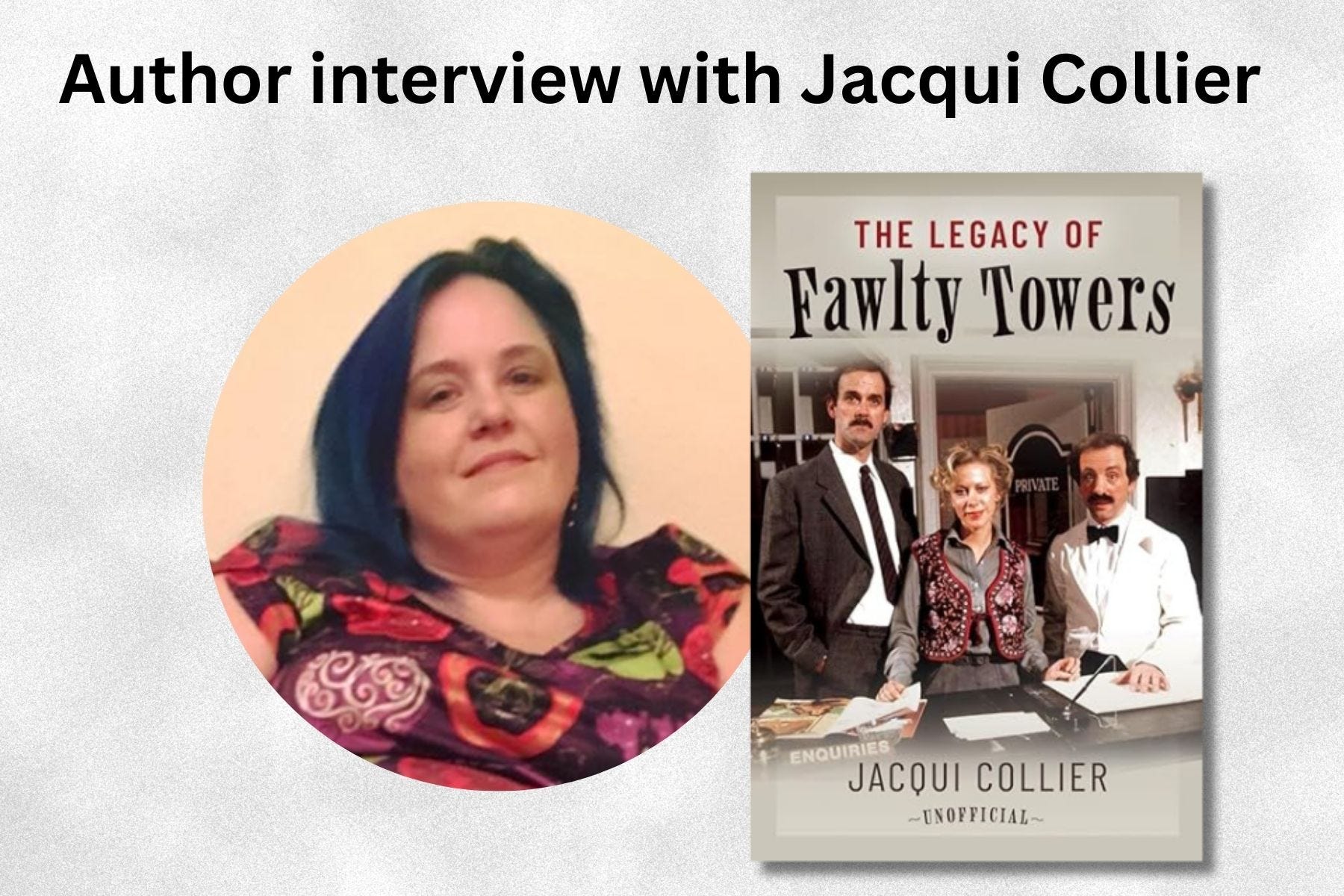
In 2025 I wrote scripts for three short films - Team Weird’s Jodiworld competition entries, although only two made it through the full edit - and my Dodo D’Or is on my windowsill behind me as I write this. I contributed to the Chronicles of St Mary’s Companion, the Sands of Time short story compilation, and my own non-fiction book came out: The Legacy of Fawlty Towers (White Owl Books), celebrating 50 years of the sitcom.
In 2026, I’ve entered Hearts Through History, and I’m sure I will contribute to future writing competitions! I’m currently looking at completing and self-publishing a similar book about The Fall and Rise of Reginald Perrin, which also reaches 50 years old this year. If I can successfully navigate the technical side of self-publishing - I have a couple of friends who have done it and promise to hold my hand through the process - then I plan future volumes on other 70s and 80s sitcoms, perhaps one a year until I run out of steam. And the current ‘bad novel’ is actually looking pretty good right now - characters behaving, plot going where I want it to, etc. It wouldn’t be the first almost-publishable one, but it might be the first one since 2015 that I actually show to anyone else.
How do you handle periods of writer’s block or creative stagnation?
I like to let things percolate. My fiction writing process is generally to hold the plot in my head ready to go, then write until I run out of words, then wait for more to come. I have written in excess of 15,000 words in a day before. Because I knew the story so well from thinking about it, all I had to do was let it out.
When I can’t decide where a bit of plot is going or what needs to happen with a character, I don’t mind just walking away from them. If my sub-conscious knows what needs to be done, I will think about it. It might be in the middle of the night three weeks later, or - with one NaNoWriMo novel, eighteen months later - but sooner or later I will know what to do. And if I cannot come up with something to fix a problem, I’m not afraid to delete.
Non-fiction is more episodic - I do “skip to a new bit” if I get bored or stuck on a section, and come back later to fill in the gaps. But because I had a contract, with money attached, and a deadline, I found it much easier to stick to my overall plan!
What advice would you offer to aspiring authors navigating the path to publication?
I don’t know if everyone struggles with writing while the dishes need doing, but I found that it’s much easier if you have somewhere else to write, outside the house. I do get less housework done, but a lot more writing. I used libraries a lot, and my trip to Orkney was invaluable. (Plus it is a lovely place. Staring at the Atlantic Ocean when you have writers’ block is much nicer than, say, the industrial buildings opposite my house.)
If you are not too fussy about what you write about, there are publishers out there looking for competent writers all the time. You won’t make a fortune, but you will get to hold your book and say: I wrote this.
How important are book reviews to you?
I’m not sure I’ve actually had any. (Goes to look.) Ah, there’s a nice positive one on Amazon. I think that means I’m not particularly bothered! It’s much nicer to receive comments from friends and fellow fans on Substack or Facebook.
Author Biography:
Jacqui lives in Oxford with a large collection of books, yarn, and hair dye. She works in university administration and dreams of writing full-time. She has recently written The Legacy of Fawlty Towers (White Owl Books, 2025) for which she interviewed Jodi, several short films for Jodiworld 2025, and this short story. She is still wrestling with her Great Unfinished Novel.*
* probably not great, definitely unfinished.
You can find Jacqui on Substack https://substack.com/@jacquicollier
and her website https://fawltyat50.co.uk/
 | A guest post by
|