

1. Time Police Writing Competition
Entry by Sandra Donovan
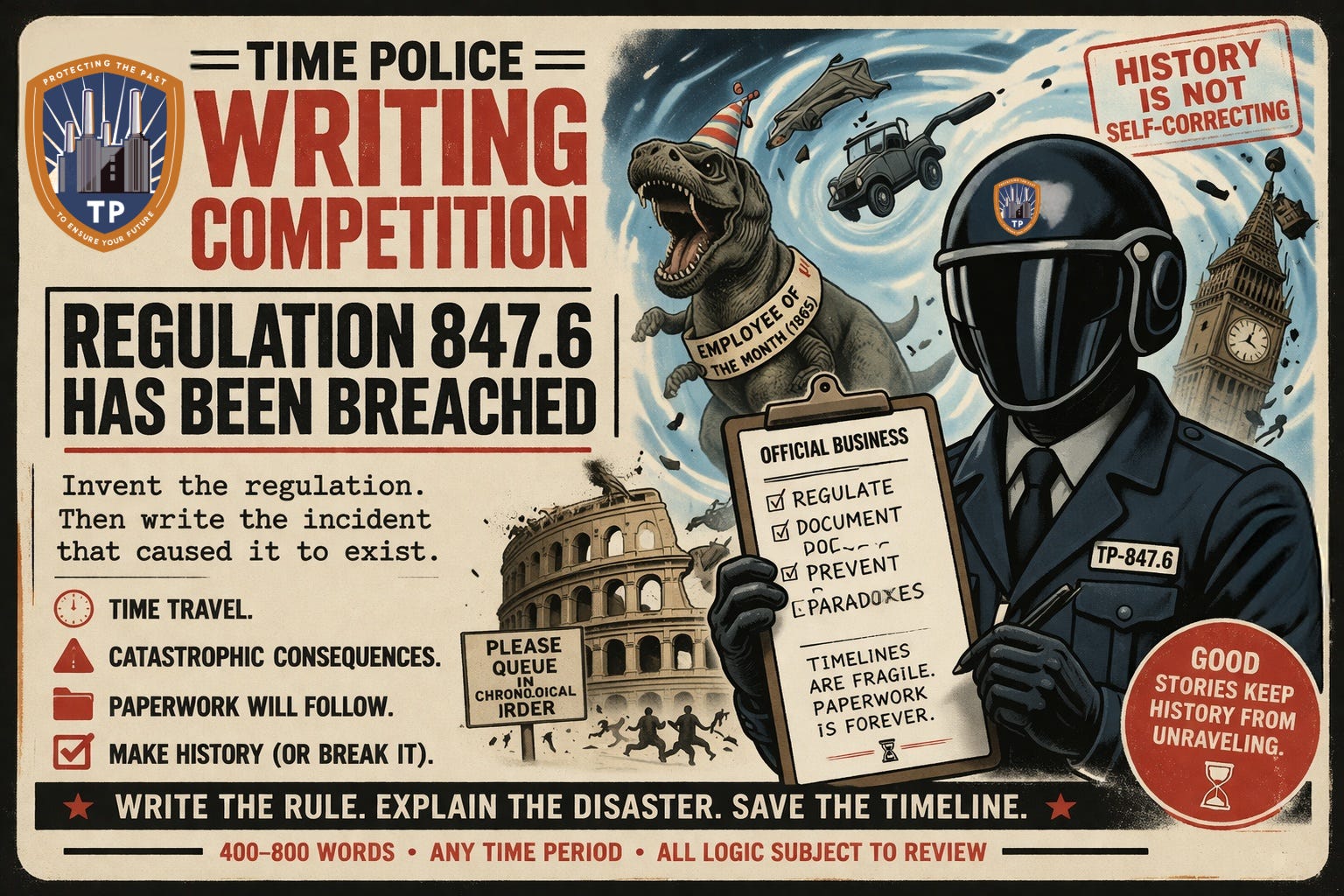
Submission by Captain Wells, Time Police - Request to create TIME POLICE Regulation 847.6
Proposed Regulation 847.6
The stated purpose of this regulation is to prohibit all and any travel to Copenhagen and Waterloo between the years 1806 and 1816 for any purpose. Temporal tourism is strictly forbidden, and any attempt to observe or interfere with documented chronological events, without prior written consent, will result in the apprehension and detention of the perpetrator. The minimum penalty for breaching this Regulation is life imprisonment, and, depending on the actions and intentions of the perpetrator, the penalty may be increased to temporary transportation and/or death.
Mitigation – no mitigating factors will be considered.
Trial by jury – no trial by jury will be allowed
Exemptions – no exemptions (not even St Mary’s)
Consultants – the Time Police may use the services of consultants to measure the potential damage caused by a breach of this regulation. Such consultants must have the required expertise and therefore, will include St Mary’s (if absolutely necessary)
Incident Report leading to the requirement for Regulation 847.6
Background
In 1807, the Royal Navy and the Army undertook a joint operation to prevent the powerful Danish fleet from falling into French hands. It ended with the British occupation of Copenhagen and the capture of Danish warships. During this conflict, General Grosvenor rode a horse named Lady Catherine. Lady Catherine delivered a foal in 1808, which was named Copenhagen in honour of the British victory. In 1815, the Duke of Wellington rode to Copenhagen at the Battle of Waterloo, defeating Napoleon in the final battle of the Napoleonic Wars.
Incident
St Mary’s Institute was conducting a study to establish whether there is any truth to the term ‘Waterloo Teeth’, which refers to the alleged custom of harvesting teeth from dead soldiers to sell for dentures.
Upon arrival at the battleground, it immediately became clear something wasn’t quite right – the French appeared to have won. At about this time, at TPHQ, an officer, whilst communing with the Time Map, noticed an anomaly in 1815. All senior staff at TPHQ were away with the senior staff from St Mary’s – team building……..
Under these unusual circumstances, I feel I had no option other than to collaborate with the remaining historians at St Marys in order to resolve the anomaly…honestly, it seemed a good idea at the time!
We jumped to Saturday, 17th June 1815, the day before the battle, to observe Wellington and his actions. It was immediately noted (by St Mary's, because why would we know anything about horses?) that he was not riding Copenhagen, his much-loved and well-documented Chestnut Arabian-thoroughbred. In fact, his horse seemed to be preoccupied with eating the local fauna and flora and had no interest in moving toward the noise of battle. In fact, at the first sound of cannon, it reared up, unseating Wellington and fled from the field, leaving the Duke lying dead on the ground with a broken neck. Without Wellington, the French would go on to win the Napoleonic Wars, the Battle of Waterloo would never have happened, and Abba wouldn’t have won the Eurovision Song Contest. St Mary's made tea, and we all had a bit of a think.
We decided to jump back to witness Wellington buying Copenhagen in 1813, and well, it just didn’t happen! Wellington took one look at the horse, decided it had ‘bad shoulders’, ate too much and passed on the purchase!
There was quite a crowd at the market, and we noticed a number of people who seemed out of place. Personally, I thought it was the colour printed photos of horses that gave them away, but St Mary’s are adamant it was their clothes - from the wrong period, apparently! We discretely observed them and noticed they kept adding corn to Copenhagen’s feeding trough. Again, according to St. Mary's, Copenhagen was known to particularly enjoy corn, which he usually ate lying down. No wonder Wellington thought him lazy.
At this point, I felt we had observed enough, and action was required. I gave the order to subdue the group of people wearing inappropriate clothing. It seems we missed. I believe it was because St Mary's, distracted by a discussion (well, an argument would be a closer description) about relevant clothing, started pointing at various examples being worn by people in the crowd. The people in the crowd took offence and surged forward. My fellow officers and I were facing the other way, about to deploy our sonics, when we were knocked over (well, nearly trampled underfoot) by the now seething, surging crowd, and so we missed. Unfortunately, Copenhagen must have caught the edge of the blast as he reared up, slipping his tether and charging at St Mary's (who I understand have at best a strained relationship with large equine beasts) and the seething, surging crowd. Wellington, seeing the danger to what he felt were helpless women (if he only knew), jumped in front of Copenhagen, who immediately stopped, lowered his head and gently rubbed his nose on Wellington’s shoulder – even I could see the bond was immediate. The crowd dissipated, leaving only the inappropriately clothed group. We promptly fire again, successfully stunning them. The purchase went ahead, and the timeline was restored.
Therefore, I request the creation of Regulation 847.6 to prevent other groups from trying to restore the French Republic and bring about the downfall of the British Empire (the stated objectives of the inappropriately clothed group).
 | A guest post by
|